
Tapestry / Architecture
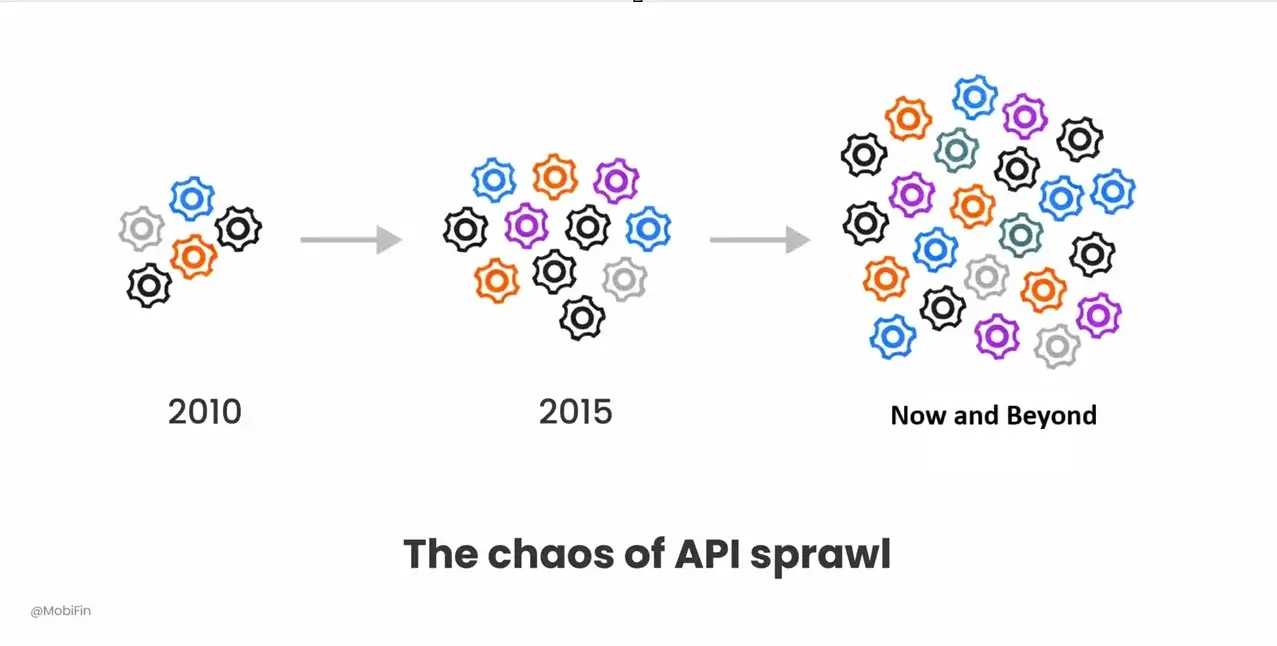
API sprawl is not an integration issue. It is a product issue.
Modern financial products are no longer built on a single system. A single customer journey can depend on dozens of APIs working together in precise sequence.
Orchestration
MobiFin Tapestry
One journey, six systems, six ways to fail
Consider a simple digital onboarding flow. Each step below relies on a different API, and every API introduces its own behavior differences, failure modes, and compliance constraints.
STEP 01Customer submits details
STEP 02Identity verified via KYC provider
STEP 03Fraud checks run in parallel
STEP 04Credit bureau is queried
STEP 05Account created in the core
STEP 06Notifications sent across channels
As APIs multiply, FinTech teams gradually lose visibility, consistency, and control over how their products actually behave. What starts as faster integration eventually turns into fragile workflows that are difficult to reason about, harder to test, and risky to scale. The result is slower launches, higher risk, and constantly failing journeys. Rather than an engineering problem, API sprawl is a product architecture problem.
The cost
Why API sprawl cripples FinTech innovation
APIs are designed to expose functionality, not to coordinate behavior. Each one behaves differently according to geography, partner implementation, environment, and load conditions. When a product depends on multiple such APIs, complexity compounds quickly.
Business logic fragments
Some rules live in backend services. Others sit inside API adapters. Some are hardcoded into workflows, and others are handled manually by operations teams. Over time, no single team understands the full end-to-end behavior of the product.
Workflows turn brittle
A small update to one API integration can trigger unexpected failures elsewhere. Compliance teams struggle to validate whether regulatory steps are consistently enforced across all paths, and every new feature needs reintegration, retest, and redeployment of multiple services.
Failures reach the customer
When APIs fail, there is generally no coordinated fallback logic. Failures propagate directly to customers as outages, stuck transactions, or broken onboarding flows, which carries regulatory, operational, and reputational risk.
The gap
The limits of traditional API management
API management tools focus on hygiene. Documentation, versioning, style guides, security policies, and governance frameworks are all necessary foundations, but they do not solve the core issue. Even with excellent API governance in place, product workflows still live in code. Logic is duplicated across teams and services. Compliance checks are manual or bolted on after the fact. Routing decisions are static. Failures propagate unpredictably. Testing environments fail to reproduce real-world behavior across systems.
The fix
Why orchestration is the only viable path
Orchestration introduces a single behavioral layer where the product’s logic lives. Instead of scattering rules across services, APIs, and downstream systems, it defines how workflows execute end to end. That layer:
- Controls sequencing across multiple APIs.
- Handles decisioning, branching, retries, and fallback paths.
- Enforces risk rules, exposure limits, and compliance checkpoints.
- Manages error handling and resilience.
- Provides governance and auditability by design.
- Keeps behavior consistent across sandbox, staging, and production.
The distinction
What API orchestration in FinTech looks like, and what it is not
FinTech API orchestration is fundamentally different from generic workflow automation. Finance requires domain awareness.
Finance as first-class logic
A financial-grade orchestration layer must understand payments, KYC states, limits, exposure, and ledger effects, not just as metadata but as first-class logic.
Correctness across parties
It must coordinate behavior across banks, processors, regulators, and ecosystem partners while preserving correctness at every step, and ensure mandatory checks are never bypassed.
Auditable state and ledger
State transitions must be deterministic and ledger movements auditable. Sandboxes must simulate orchestration behavior, not merely API responses, and rule engines must reflect financial logic rather than generic conditions.
Many workflow tools fall short here. They provide flowcharts, while finance requires product grammar.
The platform
How Tapestry solves API sprawl at its root
Tapestry, a composable FinTech platform, was built to address this problem directly. It introduces a unified orchestration layer where financial product behavior is defined once and executed consistently everywhere.
Sprawl controlled at the architectural level
Reusable financial blocks
Domain logic is encapsulated rather than duplicated across integrations. Teams no longer rebuild the same logic for every product or market.
Sandbox-led testing
Full workflows are validated, not isolated endpoints. What works in the sandbox behaves the same in production.
Decoupled iteration
Because orchestration sits apart from underlying integrations, teams iterate rapidly without touching core systems.
Compliance and risk are embedded directly into workflows rather than added later, and deterministic execution ensures predictable behavior across environments.
Outcome
The outcomes of orchestration-first architecture
The impact of orchestration compounds over time.
Most importantly, organizations gain the ability to scale product portfolios without constantly rewiring their systems.
Conclusion
API sprawl is not going away. FinTech’s increasing dependency on third-party systems guarantees that it will accelerate. The only sustainable response is not more documentation, governance, or cleanup. It is a FinTech orchestration layer that defines, governs, simulates, and executes product behavior. Tapestry makes that shift possible, giving institutions control over complexity instead of being controlled by it.